minicons: Enabling Flexible Behavioral and Representational Analyses of Transformer Language Models

This repo is a wrapper around the transformers library from Hugging Face :hugs:
Installation
Install from Pypi using:
pip install minicons
Supported Functionality
Extract word representations from Contextualized Word Embeddings
Score sequences using language model scoring techniques, including masked language models following Salazar et al. (2020), and state space models (such as Mamba).
Score sequences using VLM models (see below)
Do scoring in a quantized, multi-gpu setting.
Examples
Extract word representations from contextualized word embeddings:
from minicons import cwe

model = cwe.CWE('bert-base-uncased')

context_words = [("I went to the bank to withdraw money.", "bank"),
                 ("i was at the bank of the river ganga!", "bank")]

print(model.extract_representation(context_words, layer = 12))

'''
tensor([[ 0.5399, -0.2461, -0.0968,  ..., -0.4670, -0.5312, -0.0549],
        [-0.8258, -0.4308,  0.2744,  ..., -0.5987, -0.6984,  0.2087]],
       grad_fn=<MeanBackward1>)
'''

# if model is seq2seq:
model = cwe.EncDecCWE('t5-small')

print(model.extract_representation(context_words))

'''(last layer, by default)
tensor([[-0.0895,  0.0758,  0.0753,  ...,  0.0130, -0.1093, -0.2354],
        [-0.0695,  0.1142,  0.0803,  ...,  0.0807, -0.1139, -0.2888]])
'''
Compute sentence acceptability measures (surprisals) using Language Models:
from minicons import scorer

mlm_model = scorer.MaskedLMScorer('bert-base-uncased', 'cpu')
ilm_model = scorer.IncrementalLMScorer('distilgpt2', 'cpu')

stimuli = ["The keys to the cabinet are on the table.",
           "The keys to the cabinet is on the table."]

# use sequence_score with different reduction options:
# Sequence Surprisal - lambda x: -x.sum(0).item()
# Sequence Log-probability - lambda x: x.sum(0).item()
# Sequence Surprisal, normalized by number of tokens - lambda x: -x.mean(0).item()
# Sequence Log-probability, normalized by number of tokens - lambda x: x.mean(0).item()
# and so on...

print(ilm_model.sequence_score(stimuli, reduction = lambda x: -x.sum(0).item()))

'''
[39.879737854003906, 42.75846481323242]
'''

# MLM scoring, inspired by Salazar et al., 2020
print(mlm_model.sequence_score(stimuli, reduction = lambda x: -x.sum(0).item()))
'''
[13.962685585021973, 23.415111541748047]
'''
Computing conditional sequence scoring using LMs
s2s_model = scorer.Seq2SeqScorer('t5-base', 'cpu')

# sequence scoring for batch of input, output, by default = logprobs, can change to other quantities as needed (see minicons readme)
s2s_model.conditional_score(["What is the capital of France?", "What is the capital of France?"], ["Paris.", "Lyon."]) # the same thing works with ilm_model and mlm_model as well

'''OUTPUT:
[-6.089522838592529, -8.20227336883545]
'''

# Token-wise score of the output queries: -- <pad> token is given a score of 0.0, pass rank=True to also give token ranks
s2s_model.conditional_token_score(["What is the capital of France?", "What is the capital of France?"], ["Paris.", "Lyon."], rank=True)

'''OUTPUT:
[[('<pad>', 0.0, 0),
  ('Paris', -7.5618486404418945, 168),
  ('.', -4.617197036743164, 11)],
 [('<pad>', 0.0, 0),
  ('Lyon', -12.044157981872559, 3459),
  ('.', -4.36038875579834, 8)]]
'''
A better version of MLM Scoring by Kauf and Ivanova
This version leverages a locally-autoregressive scoring strategy to avoid the overestimation of probabilities of tokens in multi-token words (e.g., “ostrich” -> “ostr” + “#ich”). In particular, tokens probabilities are estimated using the bidirectional context, excluding any future tokens that belong to the same word as the current target token.
For more details, refer to Kauf and Ivanova, 2023
from minicons import scorer
mlm_model = scorer.MaskedLMScorer('bert-base-uncased', 'cpu')

stimuli = ['The traveler lost the souvenir.']

# un-normalized sequence score
print(mlm_model.sequence_score(stimuli, reduction = lambda x: -x.sum(0).item(), PLL_metric='within_word_l2r'))
'''
[32.77983617782593]
'''

# original metric, for comparison:
print(mlm_model.sequence_score(stimuli, reduction = lambda x: -x.sum(0).item(), PLL_metric='original'))
'''
[18.014726161956787]
'''

print(mlm_model.token_score(stimuli, PLL_metric='within_word_l2r'))
'''
[[('the', -0.07324600219726562), ('traveler', -9.668401718139648), ('lost', -6.955361366271973),
('the', -1.1923179626464844), ('so', -7.776356220245361), ('##uven', -6.989711761474609),
('##ir', -0.037807464599609375), ('.', -0.08663368225097656)]]
'''

# original values, for comparison (notice the 'souvenir' tokens):

print(mlm_model.token_score(stimuli, PLL_metric='original'))
'''
[[('the', -0.07324600219726562), ('traveler', -9.668402671813965), ('lost', -6.955359935760498), ('the', -1.192317008972168), ('so', -3.0517578125e-05), ('##uven', -0.0009250640869140625), ('##ir', -0.03780937194824219), ('.', -0.08663558959960938)]]
'''
NEW: Vision-Language Model (VLM) Scoring
Minicons now supports VLM scoring! The following code demonstrates how one can extract log-probs of caption/descriptions from Salesforce’s BLIP-2 model, conditioned on a batch of images:
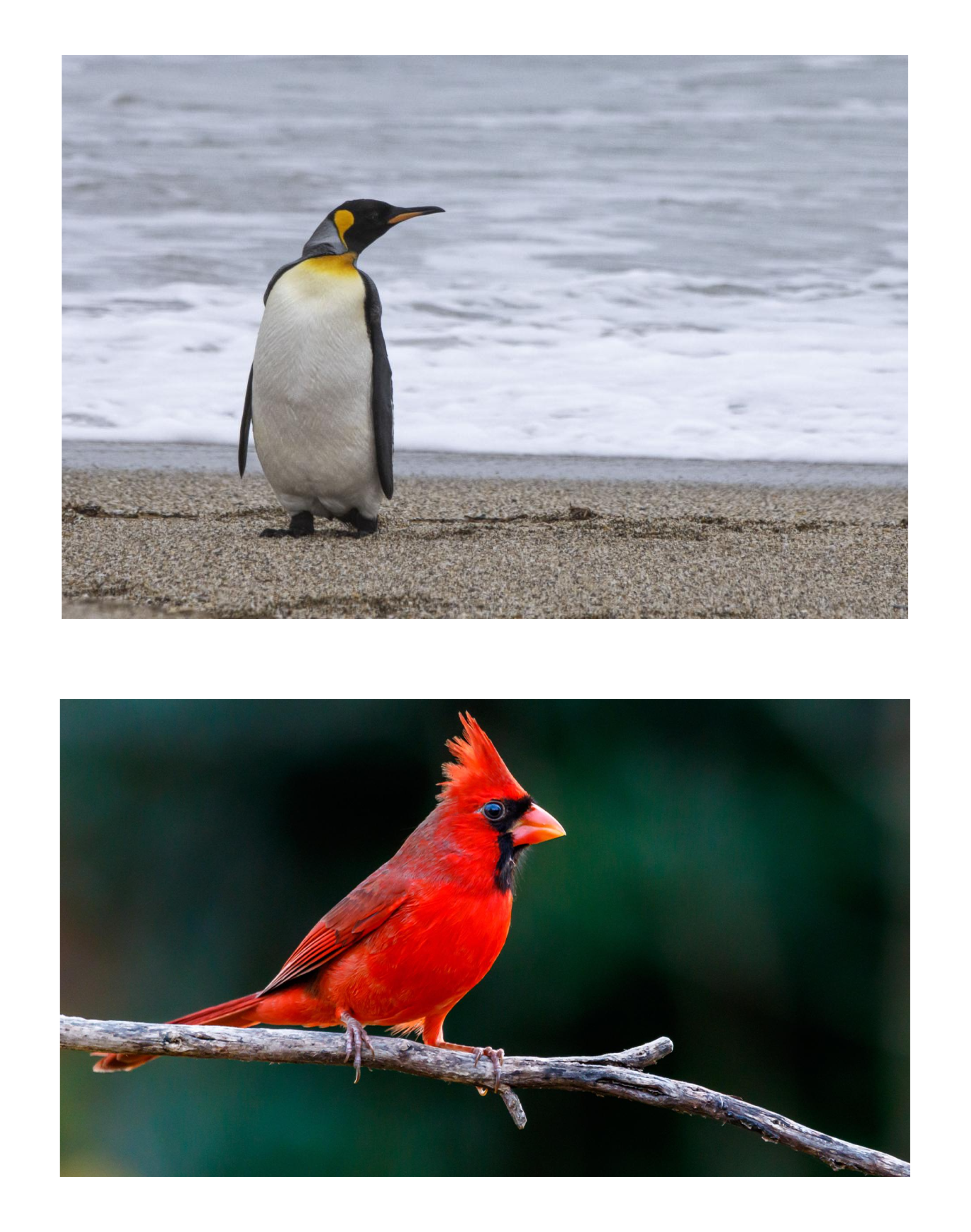
from minicons import scorer
from PIL import Image

# top image
penguin = Image.open('penguin.jpg')

# bottom image
cardinal = Image.open('cardinal.jpg')

lm = scorer.VLMScorer(
  "Salesforce/blip2-opt-2.7b",
  device="cuda:0"
)

lm.sequence_score(
  text_batch=["This bird can fly."] * 2,
  image_batch=[penguin, cardinal]
)

#> logprobs of penguin vs cardinal -> can fly
#> [-5.644123077392578, -5.129026889801025]
Tutorials
Recent Updates
November 6, 2021: MLM scoring has been fixed! You can now use
model.token_score()andmodel.sequence_score()withMaskedLMScorersas well!June 4, 2022: Added support for Seq2seq models. Thanks to Aaron Mueller 🥳
June 13, 2023: Added support for
within_word_l2r, a better way to do MLM scoring, thanks to Carina Kauf (https://github.com/carina-kauf) 🥳January, 2024: minicons now supports mamba!
Citation
If you use minicons, please cite the following paper:
@article{misra2022minicons,
    title={minicons: Enabling Flexible Behavioral and Representational Analyses of Transformer Language Models},
    author={Kanishka Misra},
    journal={arXiv preprint arXiv:2203.13112},
    year={2022}
}
If you use Kauf and Ivanova’s PLL scoring technique, please additionally also cite the following paper:
@inproceedings{kauf2023better,
  title={A Better Way to Do Masked Language Model Scoring},
  author={Kauf, Carina and Ivanova, Anna},
  booktitle={Proceedings of the 61st Annual Meeting of the Association for Computational Linguistics (Volume 1: Long Papers)},
  year={2023}
}
Famous users of minicons:
A non-exhaustive but fun list of ppl:
Adele Goldberg
Chris Potts
Najoung Kim
Forrest Davis
Marten van Schijndel
Valentina Pyatkin
Aaron Mueller
Sanghee Kim
Venkata Govindarajan
Kyle Mahowald
Carina Kauf