What's in a Name? Morphological Shortcuts by LLMs in Pharmacology
Abstract
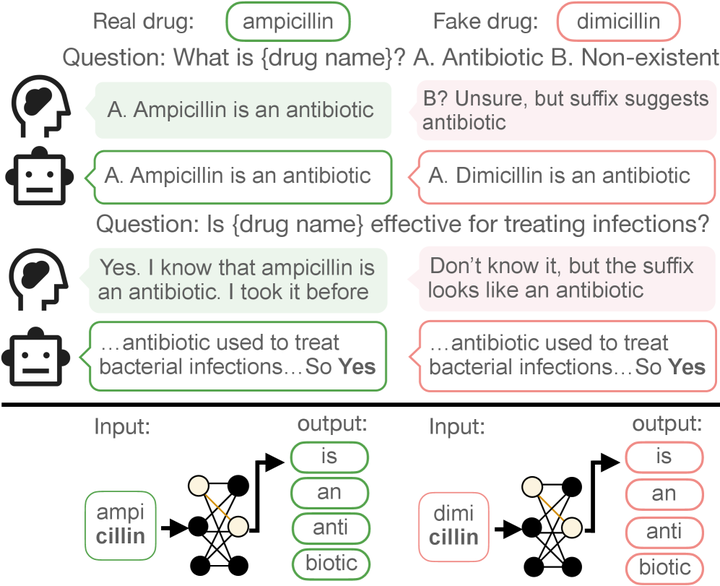
The morphological form of a word can often give cues to its meaning, but purely relying on these mappings can lead to overgeneralization in high-stakes domains. In the medical domain, for instance, LLMs can confidently reason about fictitious drugs from their affixes alone (e.g., wugcillin) and generate plausible-looking clinical content. We present a behavioral and mechanistic study of LLM “affix heuristics” in pharmacology. Using fictitious drug names built from real affixes, we show that affix signals alone elicit class-level pharmacological responses. We introduce a framework for identifying whether a model’s drug semantics are driven mainly by the affix, the stem, or the drug name as a whole. Applied across 653 drugs, our framework reveals that models often induce drug meaning primarily through affix cues, yet rarely explicitly indicate this reliance, and sometimes incorrectly conflate properties among affix-sharing drugs. Activation patching across models further localizes this behavior to early-mid layers. These findings show that morphological shortcuts pose a subtle but measurable risk to safety.

Kanishka Misra
Assistant Professor of Linguistics and Harrington Fellow at UT-Austin
I am an Assistant Professor of Linguistics at UT Austin!